
.png)
ROUNDTABLE REPORT - GOVERNANCE IN CRISIS: THE CONTENTIOUS COEXISTENCE BETWEEN CORPORATIONS AND DEMOCRACY

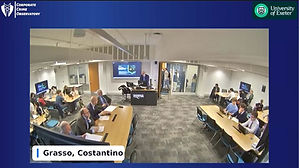
The Corporate Crime Observatory, in cooperation with the Centre for Commercial and Corporate Law at the University of Exeter and the CRN41 Economic Crime and Corporate Compliance of the Law and Society Association, is delighted to release the summary report of the international roundtable entitled "Governance in Crisis: The Contentious Coexistence Between Corporations and Democracy." Held on November 13, 2025, this hybrid event moved beyond the traditional dichotomy between wealth creation and social harm. Instead, it examined the dynamics of the “state-corporate nexus,” where a dense web of power and corporate interests can override the public good and capture the democratic process. Download the integral summary report here:
Roundtable Participants
Organizer/Moderator: Costantino Grasso (University of Exeter)
Maurizio Bianchini (University of Padova)
John Christensen (Tax Justice Network)
Richard Christensen (Former Head of Compliance)
John Cioffi (University of California, Riverside)
Mihail Danov (University of Exeter)
Konstantinos Sergakis (University of Exeter)
Summary of the Roundtable Discussion: Governance in Crisis
The international roundtable followed a structured progression, moving from a conceptual foundation to expert reflections and an interactive debate on the future of corporate accountability.
Phase I: Contextual Foundation – Capital vs. Capitalism
The session opened with a thematic screening that established a critical distinction between "capital" and "capitalism." The discussion framed capital as a constructive social force—the accumulation of human effort for future benefit. In contrast, capitalism was analyzed as a historically specific power structure that often works to undermine open markets through secrecy and the pursuit of monopoly power.
A central theme was the persistence of a "zombie ideology" in neoclassical economics. Panelists noted that while the 2008 financial crisis exposed the flaws in self-correcting market theories, these assumptions continue to dominate academic curricula and policy-making because a unified alternative has yet to take hold.
Phase II: Panel Reflections – The State-Corporate Nexus
The second phase explored how economic power is translated into political control, dismantling the binary view that the state and the market operate in isolation.
The Intersection of Power: The discussion highlighted how private power often "disappears" into the narrative of perfect markets, while corporate interests actively shape the legal and regulatory frameworks meant to oversee them.
The Failure of Gatekeepers: A significant portion of the reflection focused on the collapse of institutional checks and balances. Experts observed that auditors, non-executive directors, and the media—traditionally viewed as the "guardians" of market quality—have frequently been neutralized or captured by the entities they monitor.
Market Foreclosure: The panel examined strategies used by large firms to suppress competition, such as the abuse of intellectual property rights and the pursuit of "rent-seeking" rather than productive innovation.
Phase III: Thematic Open Discussion – Democracy and Accountability
The final phase addressed the tangible impact of corporate influence on modern governance and the potential for reform.
Real-Time Policy Rollbacks: The roundtable analyzed the immediate political pressures affecting sustainability legislation, such as the narrowing of the Corporate Sustainability Reporting Directive (CSRD). It was noted that lobbying often successfully dilutes transparency requirements, particularly those related to human rights and supply chain accountability.
The "Creative Destruction" Debate: In response to growing disillusionment, the discussion weighed the risks of systemic collapse versus institutional reform. While a "complete reset" may appear attractive in theory, the panel emphasized the devastating human cost of such a collapse, particularly for vulnerable populations.
Reclaiming Governance: The session concluded by advocating for a rebalancing of power. Suggestions included repurposing technology (such as AI) to empower citizens and shareholders, enforcing prohibitions on interlocking directorates, and utilizing international judicial cooperation to hold multinational entities accountable.
#accountability #academia #antitrust #businessethics #capital #capitalism #capture #CCO #compliance #corporate #corporatecapture #corporatecrime #corporatecrimeobservatory #corporategovernance #corporatelaw #corporateresponsibility #corporation #corruption #crisis #csr #csrd #democracy #economiccrime #economics #environment #esg #eu #europe #exeter #governance #humanrights #law #legal #lobbying #regulation #risk #ruleoflaw #society #stakeholders #sustainability #usa


Comments